Lower Newcastle, Miramichi, NB · Serving up to 100 km around the cityMiramichi, NB

Decks and patios
Miramichi Deck and Patio Builder
Grayson Construction is a deck builder in Miramichi for new decks, patios, stairs and railings, and for the decks that have gone soft, loose or uneven. A deck here carries heavy snow, sits on ground that freezes deep every winter and gets soaked every spring, so we start with the footings and the frame before we talk about boards. Daniel J. Savard runs the company from Route 11 in Lower Newcastle, and we build and repair decks up to 100 km around the city.
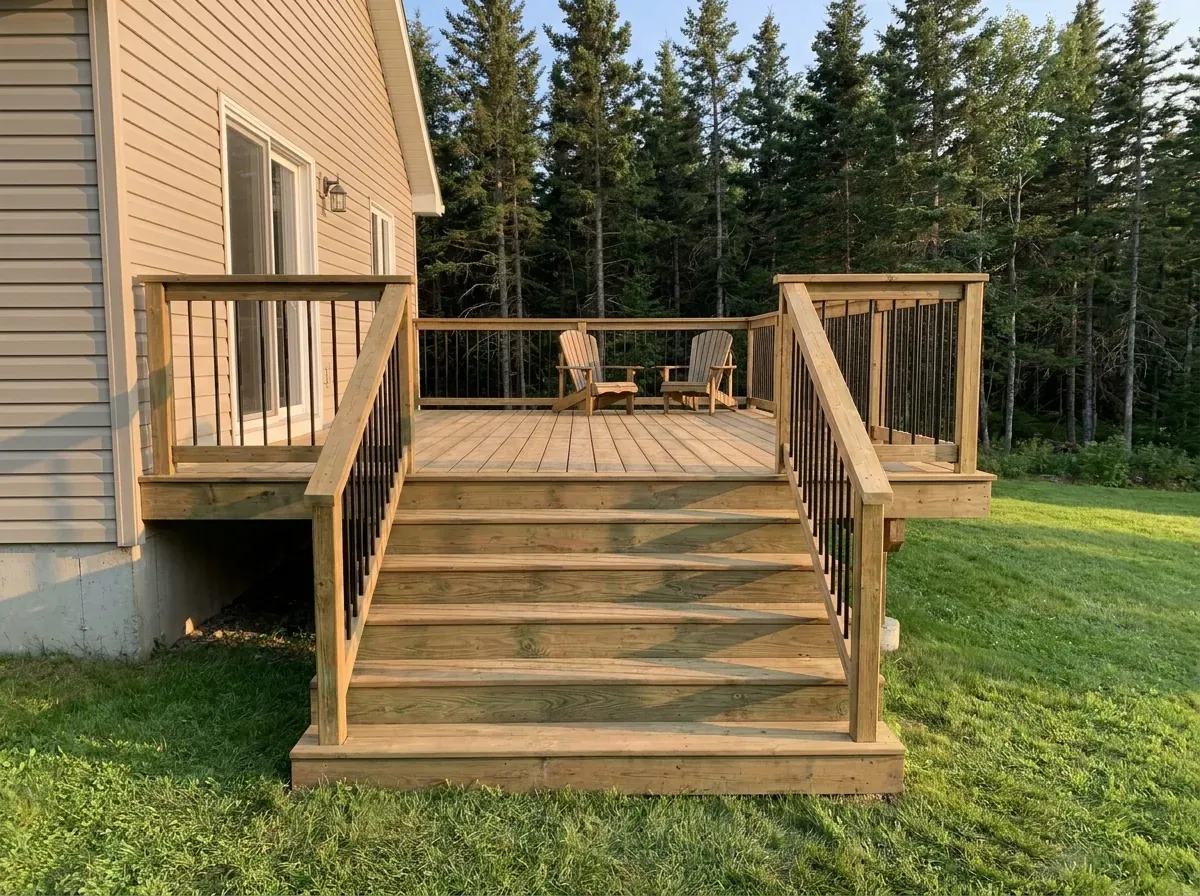
New decks
Deck Builders in Miramichi
When people compare deck builders in Miramichi, they usually look at the boards and the railing. Those are what you see, but most of what decides how long a deck lasts is underneath. Every deck is built in layers, and each one has a job:
Most decks we see around the Miramichi are one of a few kinds: a raised deck off the back door, a low deck close to the ground, a deck that wraps around a corner of the house, or a two level deck that steps down a slope. Each one starts with the same questions: how you want to use it, how much sun it gets, where the snow will pile up and how high it sits off the ground.
- 1Footings. Concrete footings or piers that carry the weight into the ground and keep the deck from moving when the ground freezes.
- 2Posts and beams. The posts stand on the footings, and the beams run across them to carry the frame.
- 3Ledger. On a deck attached to the house, the ledger is the board fastened to the house that carries one side of the frame. It needs flashing above it so water does not get behind it.
- 4Joists. The joists run between the ledger and the beam and hold up the decking. Their size and spacing decide how stiff the deck feels.
- 5Decking, railings and stairs. The part you walk on, lean on and climb.
Materials
Pressure Treated, Cedar or Composite Decking
The frame of almost every deck here is pressure treated lumber. The choice you make is mostly about the boards you walk on and the railings.
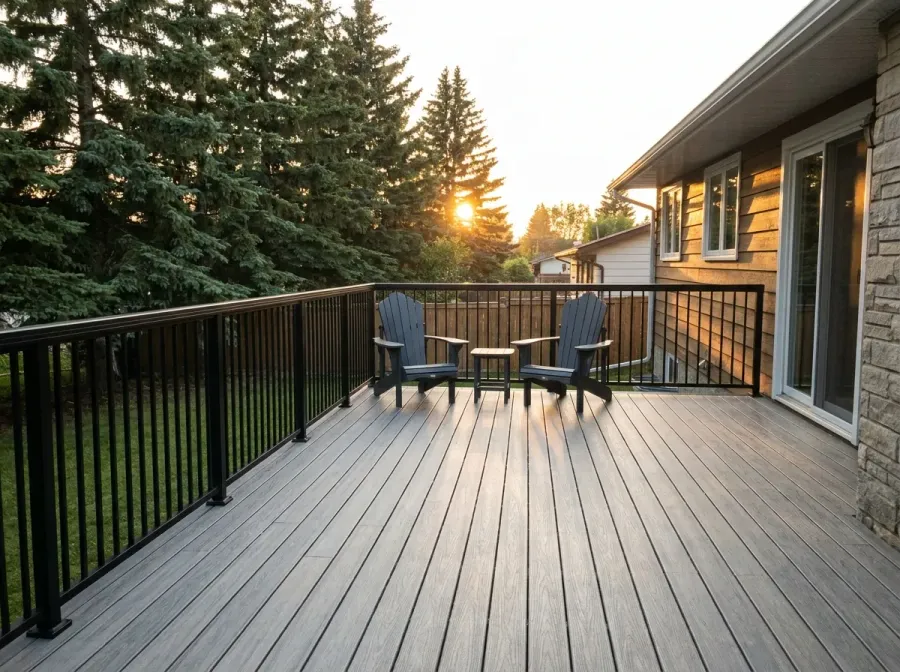
Pressure treated
- Upfront cost
- Lowest
- Upkeep
- Stain or seal every few years
- Feel and look
- Plain wood, takes stain well
- In the cold
- Can check and crack as it dries
- Repairs
- Replace single boards
Cedar
- Upfront cost
- Higher
- Upkeep
- Stain or let it weather grey
- Feel and look
- Warm, natural colour, softer wood
- In the cold
- Fairly stable
- Repairs
- Replace single boards
Composite
- Upfront cost
- Highest
- Upkeep
- Wash it, no staining
- Feel and look
- Even colour, many shades
- In the cold
- Stays the same, but check what ice melt the maker allows
- Repairs
- Matching an older colour can be hard
Composite Decking vs Pressure Treated
Composite decking costs more at the start but does not need staining, will not splinter and resists rot. Pressure treated decking costs less and is easy to repair, but it needs staining or sealing every few years to keep it from cracking and greying. Many composite boards come with manufacturer warranties of 25 years or longer. Whichever you choose, the frame underneath is still wood, so it needs the same care in how it is built and flashed.
For a deck you see every day and do not mind looking after, pressure treated or cedar is good value. For a deck you only see a few times a year, composite saves a lot of maintenance.
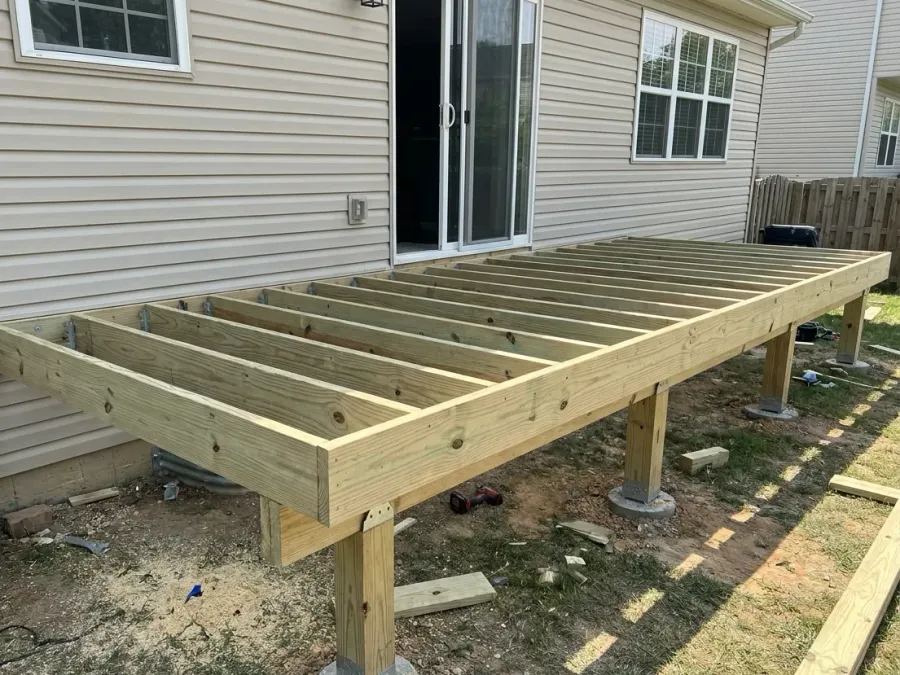
Footings
Deck Footings and Frost Heave
Frost heave lifts deck posts the same way it lifts fence posts. Water in the soil freezes and expands, and a footing that sits above the frost gets pushed up a little every winter. On a deck, that shows up as a sloping floor, a gap at the house, stairs that no longer meet the landing or a door that will not clear the decking.
- A sloping floor
- A gap at the house
- Stairs that miss the landing
- A door that will not clear the decking
The Southwest New Brunswick Service Commission's building guidance puts the depth of frost in the province at about 1.2 metres, or 4 feet, in general. A deck fastened to the house needs footings that go below the frost, because the house does not move and a heaving deck pulls against it. A low deck that stands on its own, without a ledger, is sometimes set on surface footings and allowed to move a little, as long as it is not tied to the house or to anything else that cannot move with it.
Good footings also need good ground: undisturbed soil at the bottom, water drained away from the base and posts kept off the concrete with proper post bases so the end grain does not sit wet.
Snow
Built for Miramichi Snow
A deck in New Brunswick has to be designed for snow load. A winter of heavy snow, freezing rain and drifts off the roof puts far more weight on a deck than a summer barbecue does. Under-sized joists bounce and sag, and a frame that is not tied together well can twist over time.
A few things help a deck through the winter:
The right joist size and spacing for the length of the span and the weight it carries.
Flashing over the ledger, so meltwater does not rot the house wall or the board that holds the deck up.
A plan for roof runoff. A deck under a roof edge with no gutter takes a pile of snow and ice every time the roof sheds.
Shovelling with care. Use a plastic shovel and push along the boards, not across them. On composite, check what ice melt the maker allows.
Wind matters too. Post-tropical storm Fiona in September 2022 showed how much damage wind can do across the Maritimes, and loose boards and railings are the first parts of a deck to go. Railings and stairs that are fastened properly into the frame hold up far better than ones that are toe-nailed into place.
Railings and stairs
Deck Railings, Stairs and Guards
Railings are about safety first. The National Building Code of Canada, which New Brunswick follows, requires a guard on any side of a deck where the drop is more than 600 mm, or about 2 feet. For a house, the guard is generally at least 900 mm high when the deck is no more than about 1.8 m above the ground, and 1070 mm when it is higher. Openings in the guard have to be small enough that a 100 mm sphere cannot pass through, which keeps small children from slipping between the pickets.
The usual deck railing choices are:
Wood pickets The most common and easiest to repair.
Aluminum or steel balusters Slim and low maintenance, with a better view through them.
Glass panels For an open view of the yard or the water.
Cable A modern look that suits some homes and camps.
Stairs need even rises, proper treads and a handrail you can grab. Stairs on a deck are often the first thing to go soft, because the bottom step sits close to wet ground.
Repairs
Deck Repair in Miramichi
A deck that is tired on top is not always a deck that needs replacing. For deck repair in Miramichi, we start underneath, because three parts decide whether a deck can be saved: the ledger, the footings and the joists.
| What we find | What it usually means |
|---|---|
| Rot in decking boards or railings | RepairReplace the boards or railing sections |
| Loose or wobbly railing | RepairRe-fasten or rebuild the railing into the frame |
| Soft bottom step or stringers | RepairRebuild the stairs |
| A few heaved or sunken footings | RepairReset or replace those footings |
| Rot in the ledger or the house wall behind it | Usually replaceFix the wall first, then rebuild the deck |
| Rot in many joists | Usually replaceReplace the frame |
If the frame is sound, new boards and railings can make an old deck feel new. If the ledger, footings and joists are failing, new boards on an old frame only hide the problem for a few years.
Patios
Patio Installation in Miramichi
Not every yard needs a raised deck. For a back door close to the ground, a patio is often simpler and needs no railing. There are two common ways to do it:
A ground level deck.
A low wood or composite deck on its own footings, good for uneven ground or where you want the look of a deck at ground height.
A paver patio.
Concrete or stone pavers laid on a compacted gravel base. The base is what keeps the pavers flat through frost, so it has to be deep enough, well compacted and sloped to drain away from the house.
Patio installation in Miramichi often comes with extras: a pergola for some shade, a privacy screen on the side the neighbours can see, or steps that tie a raised deck down to a patio below. If you also want the yard closed in, our fence installation page covers that side of the job.
Camps and cottages
Camp and Cottage Decks on the Southwest Miramichi
The Southwest Miramichi, from Blackville up through Doaktown, is world famous salmon water, and the river is lined with camps and cottages. Many belong to owners who live in Fredericton, Moncton or farther away and are only there for part of the season.
A camp deck has a harder life than a deck in town. It sits empty all winter under snow nobody shovels, it is often on wet ground close to the river, and small problems can go unnoticed for a whole season. For camps, it often makes sense to:
- Choose composite or cedar decking so there is less staining to keep up
- Keep the deck clear of the ground with good airflow underneath
- Use footings that suit the soil and the slope down to the water
- Plan the work for the weeks between fishing seasons
If your camp is up the river, our Blackville and Southwest Miramichi page covers the rest of the work we do in that area.
Permits and timing
Deck Permits and When to Build
In the Miramichi region, building permits go through Planning Services at the Greater Miramichi Regional Service Commission, which lists decks, ramps and stairs among the projects that need a permit. Its permit section covers attached decks, detached decks and pool enclosures. Local rules can differ, so check with the Building Inspector before the deck is booked.
Deck footings need thawed ground, so most new decks are built from late spring to the fall. Searches for deck work here peak from April to June, which is when schedules fill up. Winter is the best time to plan: decide on the size, the material and the railing, and book before the busy season. Repairs to boards, railings and stairs can often be done as soon as the snow is gone.
Planning more than a deck? Our siding contractor page covers the walls the deck is attached to, and the renovation cost guide explains what moves the price of a deck.
1How much does a deck cost?
It depends on the size, the height, the material and the ground. Composite costs more than cedar, and cedar more than pressure treated. Railings, stairs and footings add to the total, and a raised deck needs more framing than a low one. We price each deck after seeing the site, and our cost guide explains what moves the number.
2Do you need a permit to build a deck in New Brunswick?
Usually, yes. The Greater Miramichi Regional Service Commission lists decks, ramps and stairs among the projects that need a building permit, and its Planning Services handles permits in the Miramichi region. Local rules can vary, so check with a Building Inspector before the deck is booked.
3How long does a deck last?
It depends more on the frame than on the boards. A deck with footings below the frost, a flashed ledger and joists kept dry can last for decades with new boards along the way. Wood decking lasts longer with regular staining, and many composite boards carry manufacturer warranties of 25 years or longer.
4Composite or pressure treated: which is better?
Composite costs more upfront but needs no staining and resists rot, which suits camps and busy owners. Pressure treated costs less and is easy to repair one board at a time, but needs staining or sealing every few years. The frame underneath is pressure treated wood either way.
5Should I repair or replace my deck?
Check the ledger, the footings and the joists. If those are sound, replacing boards, railings or stairs is usually good value. If the ledger is rotten, many joists are soft or several footings have heaved, replacing the deck is usually better value than patching a frame that is failing.
6How high can a deck be before it needs a railing?
Under the National Building Code of Canada, a deck needs a guard on any side where the drop is more than 600 mm, or about 2 feet. For a house, the guard is generally at least 900 mm high, rising to 1070 mm when the deck is more than about 1.8 m above the ground.
Plan Your New Deck
Whether it is a new deck off the back door, a patio for the yard, a camp deck by the river or a deck that has gone soft underneath, tell us what you have in mind. As a deck builder in Miramichi and communities up to 100 km around the city, we will look at the site, check what is under the old deck if there is one and give you a price before any work starts.